

Mechanism of Action
What is THERAKOS® ECP Immunomodulation?
Extracorporeal photopheresis (ECP) is an immunomodulatory therapy that has shown efficacy in patients with systemic sclerosis and in the palliative treatment of the skin manifestations of cutaneous T-cell lymphoma that is unresponsive to other forms of treatment.1-4
How does THERAKOS® ECP Immunomodulation work?
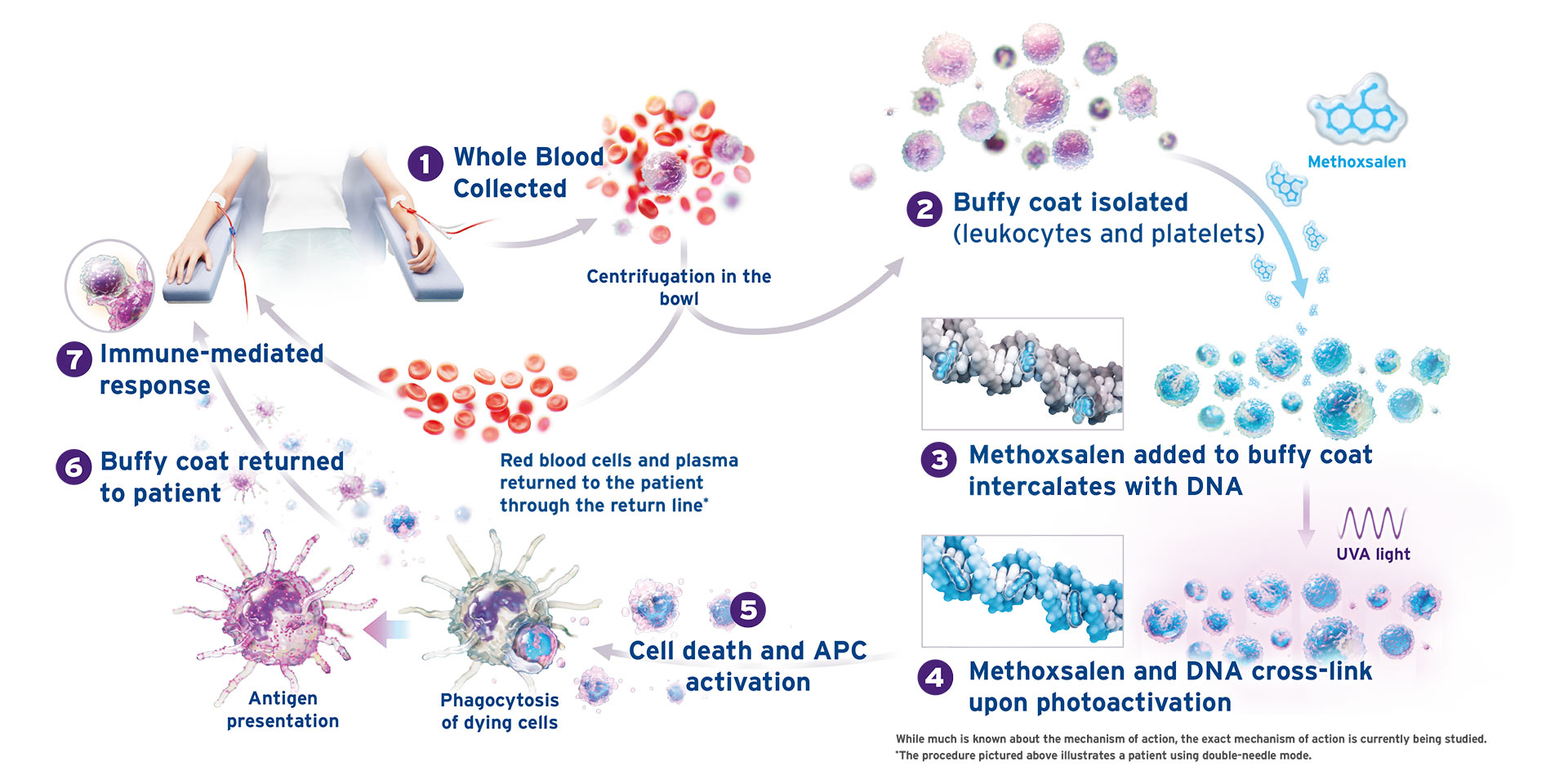
A small fraction of whole blood is collected from the patient through the collect line.5
With the help of the bowl optic sensor, the collection and control software, and the hematocrit sensor, the buffy coat is isolated following centrifugation, while the remaining red blood cells and plasma are returned.5,6
The buffy coat is transferred to the treatment bag where it is then treated with methoxsalen sterile solution, a photosensitizing agent.4,5,7,8
As the buffy coat circulates through the photoactivation module, methoxsalen is photoactivated by UVA light, which triggers cell death.5,9,10
Antigen-presenting cells (APCs) are activated and start phagocytosing dying lymphocytes.11-13
Once photoactivation is complete, the buffy coat (now containing living, dead, or dying cells, subcellular fragments, and soluble factors) is returned to the patient’s bloodstream through the return line.5
Translational studies suggest that Photopheresis may activate an immune-mediated response.3,14,15
References: 1. Hart JW, et al. Ther Adv Hematol. 2013;4:320-334. 2. Rook AH, et al. Arch Dermatol. 1992;128:337-346. 3. Knobler R, et al. J Am Acad Dermatol. 2006;54:793-799. 4. UVADEX® (methoxsalen) Sterile Solution [product monograph]. Therakos (Canada) Company. 5. THERAKOS® CELLEX® Photopheresis System Operator’s Manual. 6. Cho A, et al. Front Med (Lausanne). 2018;5:236. 7. Smith SI, Brodbelt JS. Analyst. 2010;135(5):943-952. 8. Gasparro FP, et al. Yale J Biol Med. 1985;58(6):519-534. 9. Bladon J, Taylor PC. Br J Haematol. 1999;107(4):707-711. 10. Tatsuno K, et al. Cell Death Dis. 2019;10(8):578. 11. Berger CL, et al. Int J Cancer. 2001;91(4):438-447. 12. Huang MN, et al. J Clin Invest. 2020;130(2):774-788. 13. Bladon J, Taylor PC. Photodiagnosis Photodyn Ther. 2005;2(2):119-127. 14. Shiue LH, et al. Photodermatol Photoimmunol Photomed. 2015;31(4):184-194. 15. Quaglino P, et al. Int J Immunopathol Pharmacol. 2009;22(2):353-362.

