

Cutaneous T-Cell Lymphoma (CTCL)
Reimagine Immunotherapy1-3Activate the system, target the disease3,4
Activate the system, target the disease3,4
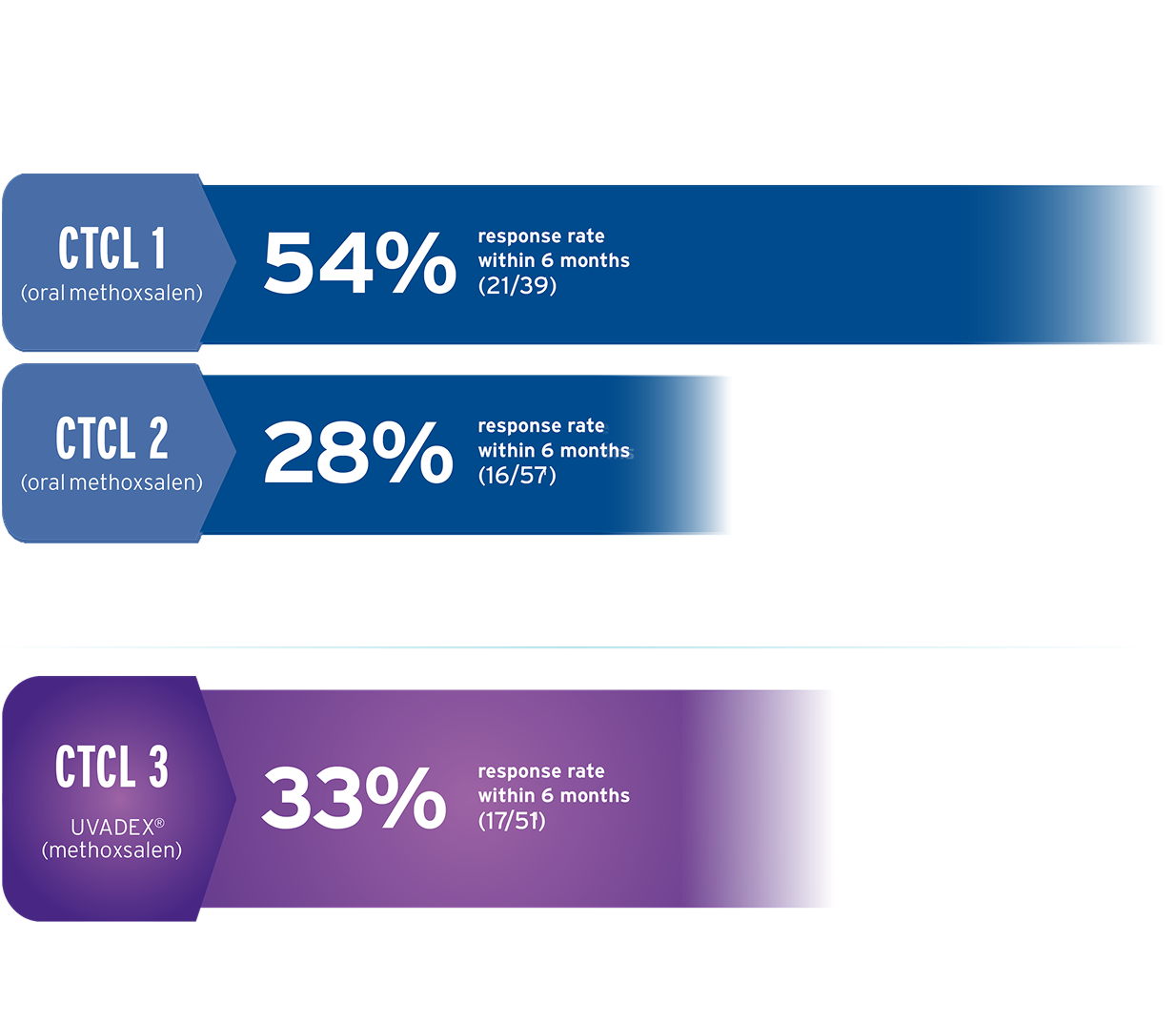
THERAKOS® Photopheresis delivered a meaningful response in clinical trials5
In 3 multicentre, single-arm, open-label trials, efficacy and safety were established in patients (N=147) unresponsive to skin-directed CTCL treatments, including tough-to-treat disease.5,6
A successful treatment response was defined as a ≥25% reduction in overall skin score from baseline maintained for 4 consecutive weeks.5
Study designs
Only patients with patch plaque, extensive plaque, and erythrodermic disease were enrolled in these studies. No patients with disease in the tumour phase were treated.5
CTCL 1 permitted prednisone up to 10 mg/day in addition to topical steroids5
CTCL 2 was a 5-year post approval follow-up to evaluate long-term safety and had no concomitant medication restriction5
CTCL 3, the clinical trial using UVADEX5,6,a
Patients had difficult-to-treat diseaseb and were on an average of 4.3 prior therapies
There are no data available regarding the efficacy of UVADEX in patients with disease in the tumour phase
Patients were only permitted to use topical steroids for the treatment of fissures on the soles of the feet and palms of the hands (all other steroids, topical or systemic, were prohibited)
In CTCL 3:
Of the 17 responses, 15 were observed within 6 months and 2 after 6 months5
Clinical experience does not extend beyond this treatment duration, and there is no evidence to show that treatment with UVADEX beyond 6 months, or using a different schedule, provided additional benefit5
Although the response rate with UVADEX in CTCL 3 was similar to oral methoxsalen in CTCL 2, the possibility that UVADEX is inferior in efficacy to oral methoxsalen cannot be excluded due to the design and size of the clinical trials. The higher response rate with oral methoxsalen in CTCL 1 may be partly due to patients receiving more treatments (mean of 64 in CTCL 1, 31 in CTCL 2, and 20 in CTCL 3) and to the administration of systemic steroids in CTCL 1.5
 Participants were not required to have blood involvement to qualify for the trials, nor were they screened for it if they met inclusion criteria based on another positive criterion.5,6
Given the chronic nature of CTCL, safety and tolerability are important considerations when choosing treatments7,8
THERAKOS® Photopheresis has been on the global market for almost 40 years with an established safety profile5,7*
Adverse events (AEs) in clinical trials were primarily related to hypotension secondary to changes in ECV (>1%)
In the UVADEX® (methoxsalen) clinical trial CTCL 3 (N=51):
6 serious cardiovascular AEs (5 unrelated to Photopheresis) were reported in 5 patients (10%)
6 infections were also reported in 5 patients
2 were Hickman catheter infections in 1 patient
4 infections were not related to Photopheresis
Adverse reactions reported from postmarketing experience included nausea, dysgeusia, photosensitivity reaction, pyrexia, and hypersensitivity reactions, including anaphylaxis and rash
Practicing proper infection control is critical to mitigating the potential for infection.

References: 1. Worel N, Leitner G. Transfus Med Hemother. 2012;39(4):254-262. 2. Stevens SR, et al. Arch Dermatol. 2002;138(10):1347-1350. 3. Tsai YC, et al. Br J Dermatol. 2023;189(5):603-611. 4. Bladon J, Taylor PC. J Photochem Photobiol B. 2003;69(2):129-138. 5. UVADEX® (methoxsalen) Sterile Solution [product monograph]. Therakos (Canada) Company. 6. Data on File – REF-25-00334. Therakos (Canada) Company. 7. Knobler R, et al. J Eur Acad Dermatol Venereol. 2020;34(12):2693-2716. 8. Referenced with permission from the NCCN Clinical Practice Guidelines in Oncology (NCCN Guidelines®) for Primary Cutaneous Lymphomas V.3.2025. © National Comprehensive Cancer Network, Inc. 2025. All rights reserved. Accessed August 26, 2025. To view the most recent and complete version of the guideline, go online to NCCN.org.
NCCN makes no warranties of any kind whatsoever regarding their content, use or application and disclaims any responsibility for their application or use in any way.
aUVADEX formulation of methoxsalen and the UVAR Photopheresis System. UVAR is no longer manufactured and was replaced by the THERAKOS® CELLEX® Photopheresis System
bDefined as exhibiting progressive disease during the prior year6
*The THERAKOS UVAR was launched in 1987. The THERAKOS UVAR XTS™ Photopheresis System was first licensed in Canada in 1999 for the palliative treatment of the skin manifestations of CTCL unresponsive to other forms of treatment.

