

THERAKOS® CELLEX® Photopheresis System

Purpose-built for photopheresis delivery and designed to meet the needs of you and your patients.
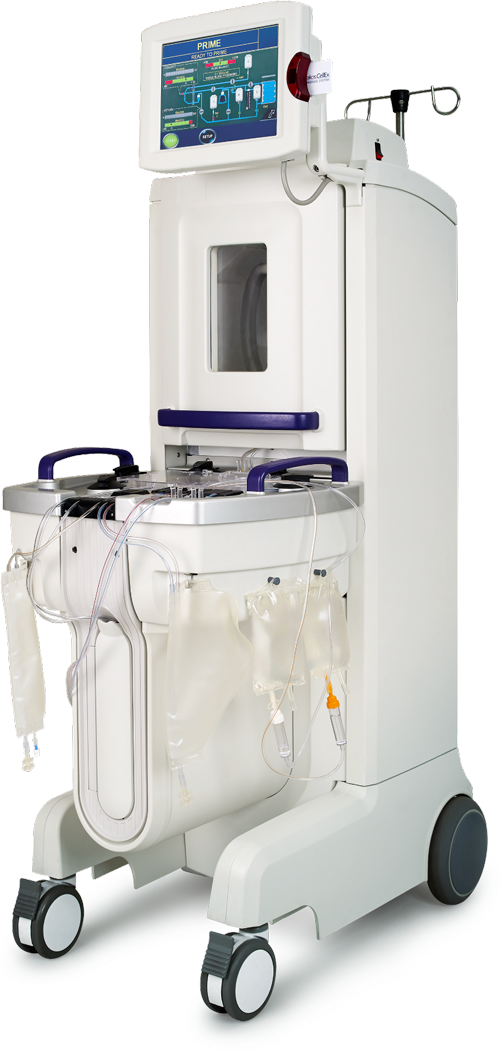
The only all-in-one device, equipped with four wheels and handle for easy transport within your unit.1*
Dimensions: 163 cm x 58.4 cm x 79 cm
Weight: 166 kg
Required Floor Space: 4614 cm2
*Please inform your Therapeutic Area Specialist (TAS) of device location changes within your unit.
Designed for efficiency in ECP administration – specifically developed to deliver ECP immunomodulation.
One kit for each procedure, helping simplify inventory, training and setup.
CLXSP-I kits for spike-port bags.
CLXCC-I kits for Correct Connect Luer-lock bags
One technology interface, with integrated touchscreen monitoring.
Canada’s only fully-integrated ECP system, designed to enhance ease of use for operators.1
A single-device workflow that eliminates the need to transfer treatment bags between devices from apheresis to photoactivation.
Multiple features to help ensure patients receive safe, adaptable, and well-controlled treatment.
Sterile closed system reduces contamination and reinfusion errors, and automated methoxsalen calculations minimize dosage errors.1
Approved for use with heparin or Anticoagulant Citrate Dextrose Solution A (ACD-A).
Treatment with the CELLEX system can be completed in as little as 75 minutes, with an average total treatment time* of 99.27 minutes.1-3
High cell collection efficiency, and consistent UVA irradiation set automatically based on remaining lamp lifetime, hematocrit of the treatment bag, and treatment volume.
*Accounts for the buffy coat collection and handling time, the irradiation time, and the handling time after treatment.3
Adaptable features to help optimize treatment for each patient.1
Choice of single- or double-needle mode based on venous access, with the flexibility to switch at any time during the procedure.
Automated flow rate controls minimize the need for operator intervention.
Bowl optic sensor adapts to abnormal plasma conditions, such as lipemia or hyperbilirubinemia.
Get to know the ECP procedure with the CELLEX® System
- The instrument collects a small fraction of blood from the patient
- The blood is separated by centrifugation
- Red blood cells and plasma are returned immediately to the patient
- A photosensitising agent* is added to the buffy coat fraction† and cells are photoactivated by UVA light
- The photoactivated buffy coat fraction† is reinfused to the patient
Please refer to the appropriate operator's manual for further details prior to prescribing ECP therapy.
*While much is known about the mechanism of action, the exact mechanism of action is currently being studied.
†The buffy coat fraction of a whole blood sample following centrifugation contains most of the white blood cells and platelets.
ECP, extracorporeal photopheresis; UVA, ultraviolet A.
Take a moment to explore the advanced functionalities
Experience & Certification
Developing ECP solutions (products, services, and education) since 1987.4
THERAKOS CELLEX Photopheresis Systems have a worldwide reach.5

Used by >300 treatment centres5

In >30 countries5

ECP kits are currently provided to >115,000 patients per year6

>1.6 million treatments5
Treatment centre information provided is for informational use only, is subject to change, and may not be comprehensive.
THERAKOS® CELLEX® Photopheresis System meets the following global quality standards:
MDR-approved technology7
The THERAKOS® CELLEX® Photopheresis System has obtained CE Certification under the Medical Device Regulation (EU MDR) 2017/745, ensuring device safety and efficacy in approved indications.
Restriction of Hazardous Substances Directive (RoHS)1,8
New RoHS3 directive-compliant CELLEX® Procedural Kits (CLXSP-I & CLXCC-I kits) comply with the latest RoHS Standard. These kits are available when machines are upgraded to the latest compatible software.
ISO 13485:2016 & EN ISO 13485:2016 certified9*
Therakos Quality Management System certified for the design, manufacture, distribution and service of Photopheresis Systems
EC Declaration of Conformity
Medical Device Regulation (EU MDR) 2017/745
Can be used safely with the materials, substances and gases with which they enter into contact
*Certified by a Notified Body (BSI Certificate of Registration number MD 665632).9
BSI, British Standards Institution; CE, Conformité Européene; EC, European Council; EU, European Union; ISO, International Organization for Standardization.
References: 1. THERAKOS® CELLEX® Photopheresis System Operator’s Manual. 2. Data on File - REF-25-00009. Therakos (Canada) Company. 3. Mayer W, et al. J Clin Apher. 2022;37(4):332-339. 4. Knobler R, et al. J Eur Acad Dermatol Venereol. 2014;28(suppl 1):1-37. 5. Data on File – REF-26-00320. Therakos (Canada) Company. 6. Data on File – REF-26-00315. Therakos (Canada) Company. 7. Data on file – REF-25-01303. Therakos (Canada) Company. 8. Data on file – REF-25-01057. Therakos (Canada) Company. 9. Data on File – REF-25-01957. Therakos (Canada) Company.

